For years, a friend of mine has been a pacer for our city’s annual marathon. If you’ve never run – or watched – a marathon, pacers are these amazing super-human people who run the entire distance at a set minutes-per-mile pace. So if you run an 8-minute mile pace, then you look for my friend with the big “8:00” sign on her shirt and you know you’ll be running that pace for 26.2 miles. (Yes, the whole way. Like I said, super-human.)
Pacers help marathoners stay on track for their goal time, or simply check their speed along the route. (Trust me, after you’re 17 miles into a race, it can get a little tough to figure out.) The ability to run a consistent speed mile after mile for many miles (or “split”, in runner’s speak) is not only amazing, it’s a crucial sanity-saver/motivator/reality-check for marathoners.
But that’s not how book pacing works.
Consistent is not better when it comes to a book’s pace. Consistent = boring. If every chapter has the same weight, types of scenes, emotional intensity, amount of dialogue and prose, syntax and rhythm, mix of action and character development, the reader loses interest. Even so-called “fast-paced, adrenaline-packed” books have quiet moments.
Think about your favorite book. Does each page march on, one after the next, like a metronome? Or is there a push-pull of action, dialogue, character development, prose and intensity throughout?
Figuring out how to pace a novel seems to fall in that murky middle-ground of “feel”: You know it when you see it, you sense it when it’s missing, but it’s hard to define in isolation. There are probably a dozen or more qualities that go into setting the pace of a book. And just like when you’re running a marathon, it’s hard to track your manuscript’s pace when you’re midway in and just trying to make it to the end.
One thing I did recently that helped? I printed my WIP. There it is in the photo below. I laid each chapter on the floor, row after row. Right away a few things became evident:
- Too-long chapters. We can debate chapter length all day, but for my WIP (a YA dramedy), several overlong chapters in a row = bad. I started looking for ways to break things up.
- Gaps. I spotted some gaps in character development, time and plot. I marked these with scrap paper and jotted notes about what was missing. Like my pacer friend with the sign on her back, those little scraps of paper are my guiding light as I finish the novel.
- Big leaps. I underestimated the build that’s necessary to get to the story’s climax. I have a tendency to write fast, but for the story to have the most payoff, I needed to slow down and insert some key scenes so the protagonist’s growth really shines.
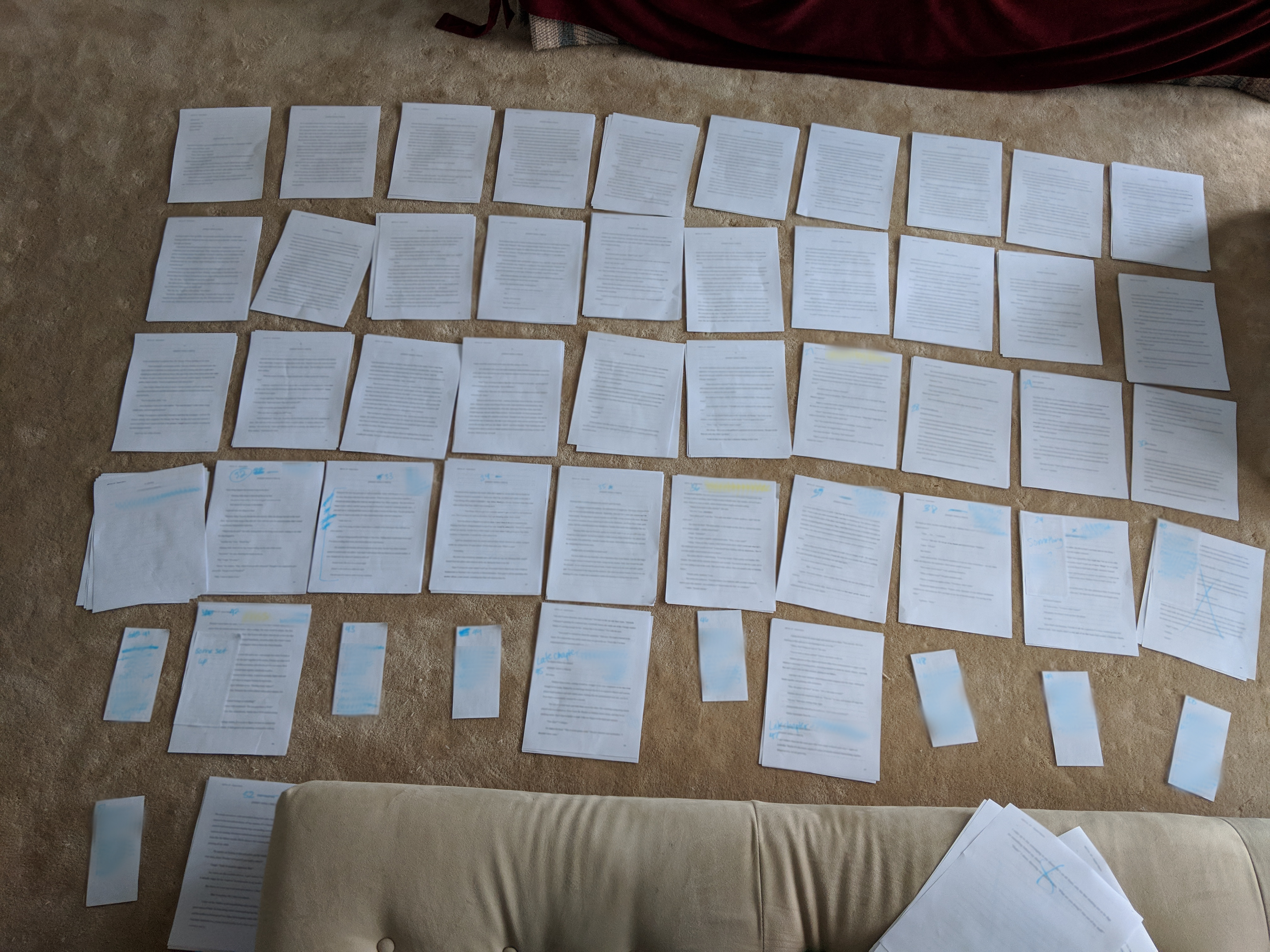
So if you find yourself stuck, or just want to check in on pace, try printing it out and taking a bird’s eye view of it. It might give you some helpful insights.
What do you do to make sure your pace is on track?
© 2019 Rachel Martin. All Rights Reserved.
 Rachel Martin
You must be logged in to post a comment.